Our first view of Mycenae.
What a view!
The secret cistern. We were all given candles and we climbed down inside. There were many, many stairs leading down to a basin from which the water was taken. I wondered to myself, "How did they manage to take large amounts of water from here? It's too cramped for a person to carry very much water at once." Then I realized, "The elite didn't care. I'm sure some poor (literally) servant was assigned this duty...for life."
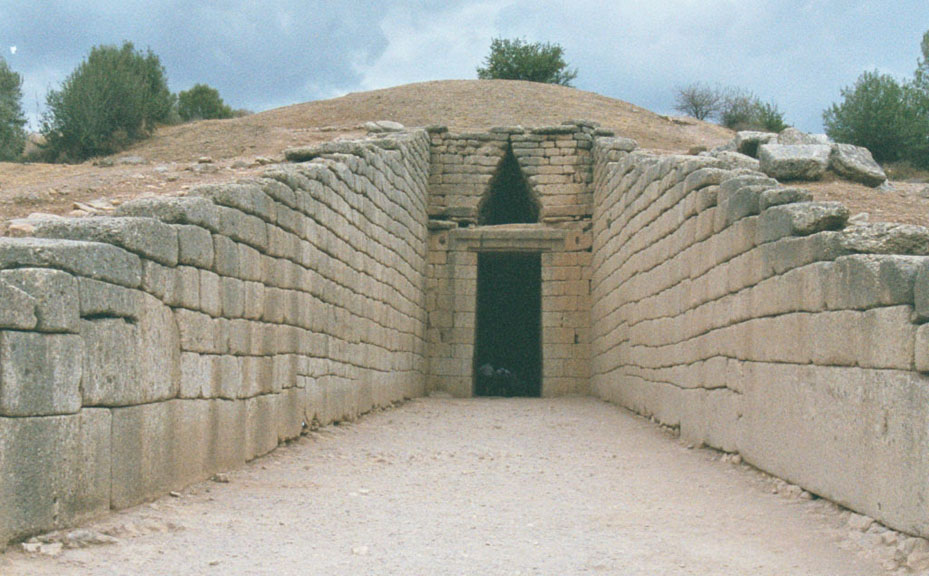
The biggest tholos tomb. Mycenae had other tombs, but none compared to this magnitude. An example of cyclopean architecture: here is a single block (with me to scale) laid as part of the wall. ONE PIECE OF ROCK!
From inside the tholos tomb, one can see the largest single cut stone block in the Aegean. It is the lintel for the doorway and weighs...120 tons. Although my photo is a bit dusty, maybe you can see that the lintel extends to the edges of the picture. You can certainly see the underside of it.
Tiryns-A Mycenaean city that acted as a port to Mycenae proper. I don't have a very good photo, so you'll just have to trust me that the entryway to this citadel was monumental in size.
Lerna-The largest "town" in the Aegean during its time. Here is the House of Tiles, the largest building in the Aegean at that time. Compare that to this domestic house, measuring about 8x10 feet. One of the amazing features of this site (other than the orange farmers reclaiming over half of it) is the spectacular preservation of early Aegean mudbrick. Miraculously, it was preserved and has been analyzed to determine what materials were used to create it. (Thank you Prof. Diamant for scale)

Sunday, February 27, 2005


Mycenae-The History of a City
The Mycenaean civilization is one of the most fascinating in ancient history. The archaeological remains were first uncovered (though some of it was in plain view) by Heinrich Schliemann. Schliemann was a very rich man who needed a hobby, so he became interested in archaeology.
[Sidenote: Schliemann and Arthur Evans, who discovered Minoan civilization, dug up the respective sites in the late 19th century. Coincidence? Two of the most notable excavations ever, occurring at roughly the same time...Why is this? Certainly there had been rich men looking for hobbies in the past. Why hadn't others found this outlet for their money? With regards to Mycenae, the famed "lion's gate" was outright visible. Shepherds and villagers knew it existed, and SEEN it, for centuries. Why wasn't it taken into consideration long before Schliemann's time? The answer has to do with the Theory of Evolution. Before Darwin, there WAS NO ancient past. Before Darwin, the earth was 4000 years old and there was no reason to look for something that simply didn't exist. At least, that's the way it was until the 19th century. (exceptions notwithstanding)]
The Mycenaean civilization was given that name because the first, and coincidentally biggest site unearthed was the citadel/city of Mycenae. There is a great debate as to if the city was an urban center or more a glorified citadel. Archaeological evidence can support both theories, but for simplicity, I'll call it a city. It is located on a hilltop next to a mountain, looking down onto a plain. The landscape provided protection against enemies. The Mycenaeans built on that site specifically because of its defensive advantages, and also because of the nature of their local economy and trade. The city was inhabited for about 5,000 years (~5000 BC-1AD) and then completely abandoned when power shifted to Argos. Of the 5000 years, only 400 are really important.
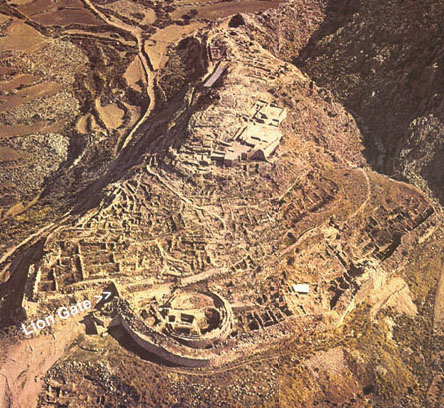
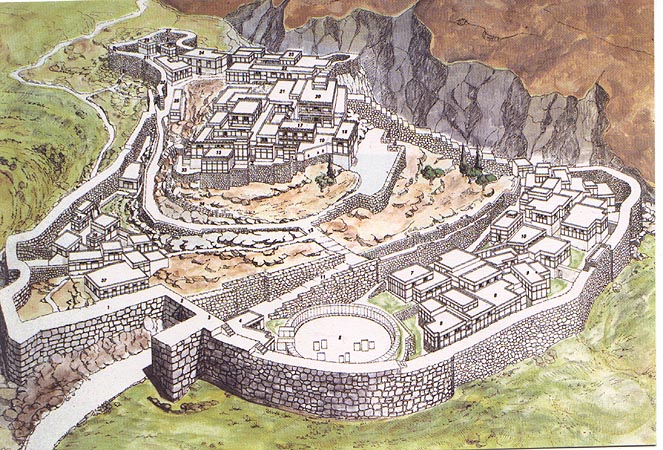
The site itself is staggering. Here is an aerial shot and reconstruction. Mycenae developed into a town in the early proto-urban period. It putted along until, suddenly, tremendous wealth was introduced.
~1600-1400 BC - Early Mycenaean Age
Most of the evidence of acquired wealth is found in graves. For about 200 years, the Mycs. were filthy, stinking rich, and one of their favorite things to do with all of this wealth was to make really ornate jewelry and weapons to bury with their dead. Grave Circle B and Grave Circle A contained extraordinary examples of these types of expensive grave goods. It is interesting to note that these goods were made for the specific purpose of being buried with the body. The pieces were not objects owned and used, then buried with the owners. We know this because, for example, the jewelry was made of delicate, thin gold leaf, intricately decorated, which could not have been worn by anybody with a pulse. Katie says, "I mean, I guess you could argue that some trophy-wife queens may not have moved much, but even they would have had to go to the bathroom eventually." These people were so rich that they practically shoveled in gold leaf "coins" to top off the burial. Also buried were weapons (swords, daggers) with that were entirely impractical. The blades were made of bronze, the handles of gold. Anyone who knows anything about metal could tell you this: a handle made of gold would be crushed under the grip of a man meeting battle, and a blade made of bronze, such as it was, could "barely cut through butter on a hot day." (Prof. Diamant)
Grave Circle B predates Grave Circle A, but GCA was discovered first by Schliemann; hence, the backwards alphabetization. (No, I don't know if that's a word or not.)
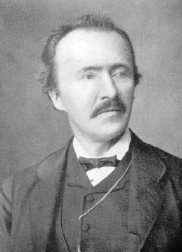
[Sidenote: Schliemann and Arthur Evans, who discovered Minoan civilization, dug up the respective sites in the late 19th century. Coincidence? Two of the most notable excavations ever, occurring at roughly the same time...Why is this? Certainly there had been rich men looking for hobbies in the past. Why hadn't others found this outlet for their money? With regards to Mycenae, the famed "lion's gate" was outright visible. Shepherds and villagers knew it existed, and SEEN it, for centuries. Why wasn't it taken into consideration long before Schliemann's time? The answer has to do with the Theory of Evolution. Before Darwin, there WAS NO ancient past. Before Darwin, the earth was 4000 years old and there was no reason to look for something that simply didn't exist. At least, that's the way it was until the 19th century. (exceptions notwithstanding)]

The Mycenaean civilization was given that name because the first, and coincidentally biggest site unearthed was the citadel/city of Mycenae. There is a great debate as to if the city was an urban center or more a glorified citadel. Archaeological evidence can support both theories, but for simplicity, I'll call it a city. It is located on a hilltop next to a mountain, looking down onto a plain. The landscape provided protection against enemies. The Mycenaeans built on that site specifically because of its defensive advantages, and also because of the nature of their local economy and trade. The city was inhabited for about 5,000 years (~5000 BC-1AD) and then completely abandoned when power shifted to Argos. Of the 5000 years, only 400 are really important.


The site itself is staggering. Here is an aerial shot and reconstruction. Mycenae developed into a town in the early proto-urban period. It putted along until, suddenly, tremendous wealth was introduced.
~1600-1400 BC - Early Mycenaean Age
Most of the evidence of acquired wealth is found in graves. For about 200 years, the Mycs. were filthy, stinking rich, and one of their favorite things to do with all of this wealth was to make really ornate jewelry and weapons to bury with their dead. Grave Circle B and Grave Circle A contained extraordinary examples of these types of expensive grave goods. It is interesting to note that these goods were made for the specific purpose of being buried with the body. The pieces were not objects owned and used, then buried with the owners. We know this because, for example, the jewelry was made of delicate, thin gold leaf, intricately decorated, which could not have been worn by anybody with a pulse. Katie says, "I mean, I guess you could argue that some trophy-wife queens may not have moved much, but even they would have had to go to the bathroom eventually." These people were so rich that they practically shoveled in gold leaf "coins" to top off the burial. Also buried were weapons (swords, daggers) with that were entirely impractical. The blades were made of bronze, the handles of gold. Anyone who knows anything about metal could tell you this: a handle made of gold would be crushed under the grip of a man meeting battle, and a blade made of bronze, such as it was, could "barely cut through butter on a hot day." (Prof. Diamant)
Grave Circle B predates Grave Circle A, but GCA was discovered first by Schliemann; hence, the backwards alphabetization. (No, I don't know if that's a word or not.)


Some of the most remarkable discoveries in the graves were the so-called "death masks." These were made of metal and shaped to form a face, or mask, that covered the dead person's. The earlier examples were made from a mixture of silver and gold, but the later ones were pure gold. They are thought NOT to be exact likenesses of the buried, but are instead based on general characteristics of the people: male, fat, etc. [At least, we HOPE they weren't exactly accurate!] Now comes the controversy. Schliemann dug up GCA and found many pretty things. However, there is one artifact in particular that legend says inspired Schliemann to telegrammed a Greek newspaper, "I have gazed on the face of Agamemnon." Schliemann was a self-mythologizer. He liked to draw connections where there were none in order to boost the impressiveness of his findings. The greatest example of this is the "mask of Agamemnon." This particular death mask was stylistically different than all the others: facial hair, ears cut out from the body of the mask. Yet Schliemann never noted this. All the graves date to at least 300 years BEFORE the Trojan war (in which Agamemnon played a part). There is no evidence that Agamemnon was buried here, and some would say not enough to believe he existed at all. The point is, some scholars have doubts as to whether this mask is Mycenaean in the first place. There are some who believe Schliemann may have forged it himself. Whatever the case may be, it is one of the most popular artifacts visited in the National Archaeological Museum in Athens.


Later Myc. Age - Mycenaean architecture shifted from the dead to the living. During this age, Mycenae was the richest city in the Aegean for 150 years. The Mycenaeans were OBSESSED with building insanely huge structures out of ridiculously massive but masterfully cut rocks. This is called "cyclopean architecture" because it was once believed that only the giant Cyclops could have moved those rocks. The site remains the way it is today because of the enormous scale of the structures. You find cyclopean, also called "monumental" architecture throughout the citadel, graves, defensive walls, and in the tholos tombs. Tholos tombs, meaning "round" tombs, were built into the sides of hills. One tomb in particular is so complicated in construction, so monumental in size that it should be called one of the world's ancient wonders. It is almost completely whole and is standing tall for visitors to admire. [It is sometimes referred to as "The Treasury of Atreus" which makes absolutely no sense and is completely innacurate.] This tomb is 3000 years old.
~1250 BC - Myc. reached its peak. Evidence: 1) A group of rich merchant houses burnt down outside the city walls. This baked hard the previously temporary clay Linear B tablets (Myc. language) that were used to keep inventories. 2) They built an elaborate secret cistern with access within the defensive walls-this suggests that the elites weren't too happy with what was happening on the outside. 3) Exports of pottery ceased.
~1200 BC - Inside the citadel caught fire, but the palace was spared. The population declined and no more monumental architecture was undertaken.
~1150 BC - A fire destroyed the palace.
After 1150 BC - The site continued to be occupied, but its role was greatly diminished. Other cities (such as Argos) increased in power.
~1 AD - The site was completely deserted.
Aspects of the Mycenaean civilization:
They were willing to rip off anybody. Mycenaean art is a blatant conglomeration of various artforms, motifs, and materials of other cultures like the Minoans or Cyclades. It is quite obvious and they were not ashamed of it.
They loved gold. One look at the excavated grave goods and you can only begin to imagine what they didn't put in with their dead.
They were megalomaniacs. They built big buildings...because they could. The defensive walls were exponentially bigger than they ever needed to be. One American army officer commented that it would take at least three blasts from a howitzer to break through that amount of rock. They must have been paranoid as well. Exactly what this little prehistoric town of farmers and traders felt it needed to defend itself from is still a mystery . . .
This society was sharply divided between the elite and everyone else. While the elite (10% of pop.) was buried with fortunes, the rest of the population was dirt-poor. It must have sucked for most of them. (No, I don't believe that is the scientific term.)
Wednesday, February 23, 2005
Monday, February 21, 2005
Photos-Nafplion!
After a long and arduous struggle, these photos are brought to you by the letter, "ψ" because it is the coolest of Greek letters.
Nafplion-
On our afternoon off, Katie, Meredith, Sarah, and I happened upon one of the best gelato places we've ever experienced. I had the caramel, tiramisu, and pistaccio. Yum.
We took a nice stroll down to the beachfront. (Katie and Noelle)
That night we loosened up at a local taverna with some of the best Greek food we've had yet. Mom and dad would be proud. (both sets)
Palamidi-
Here's a view of the Palamidi fortress from the water's edge.
The bus drove us up to the lower end of the fortress, so Katie and I climbed up to the top. Katie had to take a break for a picnic on the roof. (It's an inside joke with her family. Apparently, this photo was taken to exact revenge upon her mother who told her that the roof is no place for a picnic.)
The top of the fortress provided a spectacular view of the mountains behind the city and the peninsula upon which the sity was built. I had to take some time to contemplate.
Since there was no one else around, Katie and I had to take our own photos.
Being the type of people that we are, we took the fastest way down. I enjoyed this exercise. It looks a lot more daunting from this angle.
More to come.
Nafplion-
On our afternoon off, Katie, Meredith, Sarah, and I happened upon one of the best gelato places we've ever experienced. I had the caramel, tiramisu, and pistaccio. Yum.


We took a nice stroll down to the beachfront. (Katie and Noelle)


That night we loosened up at a local taverna with some of the best Greek food we've had yet. Mom and dad would be proud. (both sets)

Palamidi-
Here's a view of the Palamidi fortress from the water's edge.

The bus drove us up to the lower end of the fortress, so Katie and I climbed up to the top. Katie had to take a break for a picnic on the roof. (It's an inside joke with her family. Apparently, this photo was taken to exact revenge upon her mother who told her that the roof is no place for a picnic.)

The top of the fortress provided a spectacular view of the mountains behind the city and the peninsula upon which the sity was built. I had to take some time to contemplate.


Since there was no one else around, Katie and I had to take our own photos.


Being the type of people that we are, we took the fastest way down. I enjoyed this exercise. It looks a lot more daunting from this angle.


More to come.
Tuesday, February 15, 2005
Nafplion-The City with a History
Our hotel was located in Nafplion, a city that happens to be in an excellent location, both relative to the archaeological sites and in a general sense.
Nafplio, also called Nafplion
When first approaching this city, it appears cute, quaint, and relaxed. It wasn't tourist season yet, so the streets were relatively uncrowded, the exceptions being locals. Nafplion sits on a peninsula of strategic importance to the Peloponnese.
In ancient times, Nafplion made a great port for the nearby powerful city of Argos. Because of the location's commercial advantages, it was sacked by Venetian traders (known skilled merchants) who secured the port and used it for their own trading industry. The local population suffered greatly under the Italian rule and many welcomed the later Ottoman invasion that forced the Venetians out. This power turnover occurred when the Turks climbed a big hill next to the city's stronghold and shot their big canons down onto it. The Venetians got scared, jumped in their little boats, and sailed away. (No word on if they wore striped shirts and sang tragic songs from their gondolas.) The Turks built a big mosque and with a Islamic school attached, but aside from that, they pretty much left the townspeople alone for the next hundred years or so. During this time, Nafplion was pretty quiet.
Then the Venetians decided they had gathered enough strength to fight back, so they brought bigger guns, climbed up the that same hill overlooking the stronghold, fired down on the city, and "freed" Nafplion from the Ottoman Empire. One of first contributions to the city was turning the Islamic school into a prison. Though christians themselves, the Venetians did little to gain the prasises of the locals. Neither the townspeople nor the overworked and underpaid Venetian soldiers sent to occupy the area were very happy with this arrangement.
The Venetians, in a light bulb moment, had caught onto the fact that the big hill next to the stronghold might be a strategic weakness as far as defense of the city was concerned. Therefore, they decided to build a huge, "impregnable" fortress on top of it, eliminating the possibility of deja-vous. This is called the Palamidi fortress. So intent on securing the city were they, that the entire fortress, which is actually an impressive series of interconnected bastions, was built in a period of just four years. The underpaid and overworked Venetian soldiers who constructed it were pretty tired, hungry, and fed up by the time they finished the Palamidi along with the 1,000 stepped-staircase leading up to it. [photo from Palamidi, looking down at the stronghold] Again, the Turks came along with their bigger guns. Only this time, they met little resistance. In essence, the Venetians soldiers took one look at the Turks, threw down their weapons and said, "To hell with it." They ran out of the bastions via their recently-constructed covered walkways: some disappeared into the woodwork, while others took the conveniently located seaside stairs to their little boats, and went home. The Venetian nobles had to find their own way home, and they did so...quickly.
Just when you thought the story couldn't get any more ironic, the invincible fortress of Palamidi played a role in the Greek War of Independence when a local hero took it upon himself to scale the supposedly un-scale-able cliff side of the fortress, sneak over the walls and throw open the main gates. The Turks, who faced much bigger problems elsewhere in the mainland were defeated. So there you have it: the "impregnable" fortress batted .000, being brought down twice on two attemptes, and there was much rejoicing.
Once Greece became independent, Nafplion was very briefly made the new country's capitol. The mosque and Islamic school that had been turned into a prison by the Venetians was recycled yet again. It became the building in which the first Greek parliament met. Is was here that the first governor of the nation, Ioannis Kapodistrias was assassinated. Not long after that, the king of Greece moved the capitol to the more populous, and historical capitol, city of Athens. Since then Nafplion has returned to a quiet, vacation destination. [If I've confused you, here is a link to a short history of Nafplion.]
One of the remnants of the Venetian rule is a small Greek Catholic population. We walked by a Catholic church, but during the winter masses are held only once a month because the priest travels into the city.
I'm not sure if this is connected to the Venetians, but there is a gelato place with the best gelato I've ever had. I will try to upload some pictures of it soon.
Our group took the bus up to the top of the Palamidi. Katie and I walked all the way to the top and took photos (also to be uploaded soon). After gawking at the gorgous Mediterranean, we took each and every of the 991 steps to the bottom. It was amazing. Whenever we had spare time, we ate great Greek food and hung out by the sea. The locals were polite and seemed much more relaxed than their Athenian contemporaries. Hell, if I lived in a place like this, I'd be relaxed too.
Nafplio, also called Nafplion
When first approaching this city, it appears cute, quaint, and relaxed. It wasn't tourist season yet, so the streets were relatively uncrowded, the exceptions being locals. Nafplion sits on a peninsula of strategic importance to the Peloponnese.

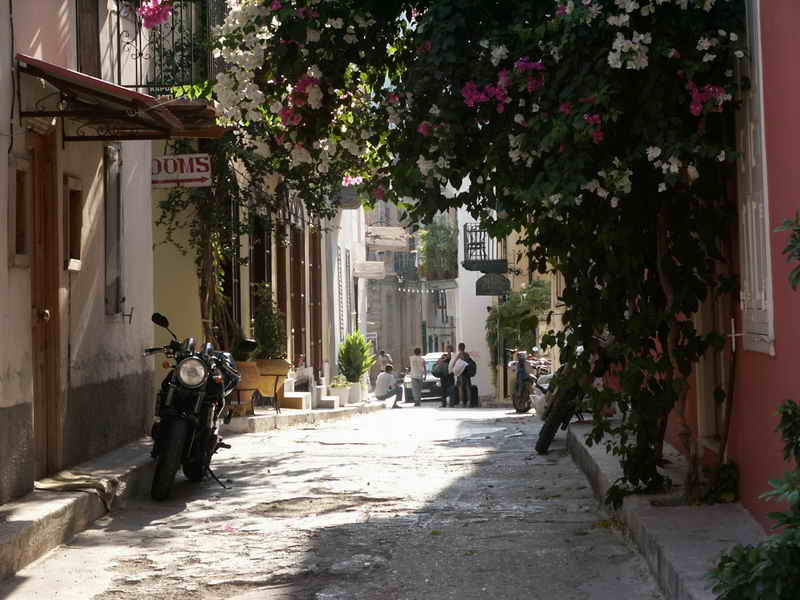
In ancient times, Nafplion made a great port for the nearby powerful city of Argos. Because of the location's commercial advantages, it was sacked by Venetian traders (known skilled merchants) who secured the port and used it for their own trading industry. The local population suffered greatly under the Italian rule and many welcomed the later Ottoman invasion that forced the Venetians out. This power turnover occurred when the Turks climbed a big hill next to the city's stronghold and shot their big canons down onto it. The Venetians got scared, jumped in their little boats, and sailed away. (No word on if they wore striped shirts and sang tragic songs from their gondolas.) The Turks built a big mosque and with a Islamic school attached, but aside from that, they pretty much left the townspeople alone for the next hundred years or so. During this time, Nafplion was pretty quiet.
Then the Venetians decided they had gathered enough strength to fight back, so they brought bigger guns, climbed up the that same hill overlooking the stronghold, fired down on the city, and "freed" Nafplion from the Ottoman Empire. One of first contributions to the city was turning the Islamic school into a prison. Though christians themselves, the Venetians did little to gain the prasises of the locals. Neither the townspeople nor the overworked and underpaid Venetian soldiers sent to occupy the area were very happy with this arrangement.
The Venetians, in a light bulb moment, had caught onto the fact that the big hill next to the stronghold might be a strategic weakness as far as defense of the city was concerned. Therefore, they decided to build a huge, "impregnable" fortress on top of it, eliminating the possibility of deja-vous. This is called the Palamidi fortress. So intent on securing the city were they, that the entire fortress, which is actually an impressive series of interconnected bastions, was built in a period of just four years. The underpaid and overworked Venetian soldiers who constructed it were pretty tired, hungry, and fed up by the time they finished the Palamidi along with the 1,000 stepped-staircase leading up to it. [photo from Palamidi, looking down at the stronghold] Again, the Turks came along with their bigger guns. Only this time, they met little resistance. In essence, the Venetians soldiers took one look at the Turks, threw down their weapons and said, "To hell with it." They ran out of the bastions via their recently-constructed covered walkways: some disappeared into the woodwork, while others took the conveniently located seaside stairs to their little boats, and went home. The Venetian nobles had to find their own way home, and they did so...quickly.
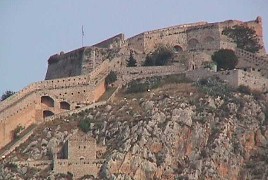

Just when you thought the story couldn't get any more ironic, the invincible fortress of Palamidi played a role in the Greek War of Independence when a local hero took it upon himself to scale the supposedly un-scale-able cliff side of the fortress, sneak over the walls and throw open the main gates. The Turks, who faced much bigger problems elsewhere in the mainland were defeated. So there you have it: the "impregnable" fortress batted .000, being brought down twice on two attemptes, and there was much rejoicing.
Once Greece became independent, Nafplion was very briefly made the new country's capitol. The mosque and Islamic school that had been turned into a prison by the Venetians was recycled yet again. It became the building in which the first Greek parliament met. Is was here that the first governor of the nation, Ioannis Kapodistrias was assassinated. Not long after that, the king of Greece moved the capitol to the more populous, and historical capitol, city of Athens. Since then Nafplion has returned to a quiet, vacation destination. [If I've confused you, here is a link to a short history of Nafplion.]
One of the remnants of the Venetian rule is a small Greek Catholic population. We walked by a Catholic church, but during the winter masses are held only once a month because the priest travels into the city.
I'm not sure if this is connected to the Venetians, but there is a gelato place with the best gelato I've ever had. I will try to upload some pictures of it soon.
Our group took the bus up to the top of the Palamidi. Katie and I walked all the way to the top and took photos (also to be uploaded soon). After gawking at the gorgous Mediterranean, we took each and every of the 991 steps to the bottom. It was amazing. Whenever we had spare time, we ate great Greek food and hung out by the sea. The locals were polite and seemed much more relaxed than their Athenian contemporaries. Hell, if I lived in a place like this, I'd be relaxed too.


Field Trip!
This weekend we all took a field trip to the Argolid. The Argolid is a region of Greece most known for the cities of Argos, Corinth, and Nafplion. Here's a map. It is also known for the astounding archaeological sites of Mycenae, Tiryns, Lerna, Epidauros, and Franchthi Cave, all of which we visted. The trip was an intense three-day learning experience. Therefore, I'm going to post each section individually. Bear with us while Katie and I try to put most of it down into words.
Katie:
At 6:30 am on Friday morning (a time which, after high school, I ceased to believe existed), two wrist watch alarms and a cell phone went off in the room that Noelle and I share. Much to our relieved surprise, we both woke up and painfully made our way to the Academic Center to board a bus to the Argolid, the easternmost area of the Peloponnese, which is basically the southern and westernmost region of the Greek mainland. Technically, I think the Peloponneseis more or less an island now because the Corinth canal cuts right through the little strip of land that connects it to the rest of the mainland. The important part, as far as I'm concerned, lies in the reality of this place being a gorgeous, mountainous region with famous prehistoric archaeological sites.
Katie:
At 6:30 am on Friday morning (a time which, after high school, I ceased to believe existed), two wrist watch alarms and a cell phone went off in the room that Noelle and I share. Much to our relieved surprise, we both woke up and painfully made our way to the Academic Center to board a bus to the Argolid, the easternmost area of the Peloponnese, which is basically the southern and westernmost region of the Greek mainland. Technically, I think the Peloponneseis more or less an island now because the Corinth canal cuts right through the little strip of land that connects it to the rest of the mainland. The important part, as far as I'm concerned, lies in the reality of this place being a gorgeous, mountainous region with famous prehistoric archaeological sites.
Monday, February 14, 2005
Stavros the Cook
Katie's adventures in cooking class:
Thursday night was my first Greek Cooking lesson in which we actually cooked food. Stavros, the chef, is absolutely delightful. Like any good chef, he is a kitchen Nazi, but he tries very much to unclench his fists of control and let his students help out with some of the tasks. He generally maintains a sort of half-crazed grin through most of his instruction, and he throws in a quirkywink every now and then.
His genius is apparent at all times. "Right, so I will have all of your emails, so the recipes should arrive in your mailboxes by Saturday afternoon," Stavros says, for instance. "And you will have my information, so you will contact me. If you want to go to a restaurant, you will call Stavros. If you want to go to a bar, eh, well, bars are, how do you say, no big deal, but you will call Stavros and I will tell you where to go. There's a lot of crap in Athens, and I don't want you to waste your time. Endaxi. (which is basically Greek for 'that's settled.')"
As a side note to help you envision this man and my thorough amusement with him, I have tell you about a Hallmark card I received a few years ago for my birthday. The front of the card features a very burly circus performer in a leotard, and the card says something like, “Paco will show you many things if you will go with Paco, but Paco will not beg.” The inside of the card says,“Whatever you do for your birthday, don't go with Paco.” Although Stavros is a fairly thin man who wears a chef's jacket and wind pants, he reminds me very much of Paco. Whenever Stavros makes a mistake while cooking, he sings a little song to himself. It goes like this: “I dooo not like it when I dooo this.”
Speaking of mistakes, Stavros tried to teach our class of eleven how to flip the sautéing contents (which, in Greek cooking, consist primarily of olive oil) of a frying pan with a flourish. When the first girl who tried this succeeded in scattering a large amount of oil-coated garlic and diced onions all over her arm and the floor, Stavros winked at her and said, “Right, well, this happens. This is why we cooks always have tomato concentrate in our kitchen; it is good for the burns,” as he slopped tomato paste over her scalded skin.
In spite of the mishap, we managed to prepare a pretty glorious feast of Greek salad, bean soup, seasoned potatoes, saganaki (fried cheese), and chicken with lemon sauce. Stavros, however, was less than impressed with the beverages our cafeteria offered. “Ugh,” He said. “Dinner, without wine, is like island, with no sea. We must have some wine for next week. At least a beer.”
Thursday night was my first Greek Cooking lesson in which we actually cooked food. Stavros, the chef, is absolutely delightful. Like any good chef, he is a kitchen Nazi, but he tries very much to unclench his fists of control and let his students help out with some of the tasks. He generally maintains a sort of half-crazed grin through most of his instruction, and he throws in a quirkywink every now and then.
His genius is apparent at all times. "Right, so I will have all of your emails, so the recipes should arrive in your mailboxes by Saturday afternoon," Stavros says, for instance. "And you will have my information, so you will contact me. If you want to go to a restaurant, you will call Stavros. If you want to go to a bar, eh, well, bars are, how do you say, no big deal, but you will call Stavros and I will tell you where to go. There's a lot of crap in Athens, and I don't want you to waste your time. Endaxi. (which is basically Greek for 'that's settled.')"
As a side note to help you envision this man and my thorough amusement with him, I have tell you about a Hallmark card I received a few years ago for my birthday. The front of the card features a very burly circus performer in a leotard, and the card says something like, “Paco will show you many things if you will go with Paco, but Paco will not beg.” The inside of the card says,“Whatever you do for your birthday, don't go with Paco.” Although Stavros is a fairly thin man who wears a chef's jacket and wind pants, he reminds me very much of Paco. Whenever Stavros makes a mistake while cooking, he sings a little song to himself. It goes like this: “I dooo not like it when I dooo this.”
Speaking of mistakes, Stavros tried to teach our class of eleven how to flip the sautéing contents (which, in Greek cooking, consist primarily of olive oil) of a frying pan with a flourish. When the first girl who tried this succeeded in scattering a large amount of oil-coated garlic and diced onions all over her arm and the floor, Stavros winked at her and said, “Right, well, this happens. This is why we cooks always have tomato concentrate in our kitchen; it is good for the burns,” as he slopped tomato paste over her scalded skin.
In spite of the mishap, we managed to prepare a pretty glorious feast of Greek salad, bean soup, seasoned potatoes, saganaki (fried cheese), and chicken with lemon sauce. Stavros, however, was less than impressed with the beverages our cafeteria offered. “Ugh,” He said. “Dinner, without wine, is like island, with no sea. We must have some wine for next week. At least a beer.”
Thursday, February 10, 2005
Michael Shanks?
Ok, so this post has nothing to do with Greece, except that it happened to occur at CYA.
So Katie and I were eating lunch, and she left to go check her email. Now, those of us who know Katie understand how much time she needed. Therefore, I was left to finish my kiwi and coffee...alone. This happened to be perfectly fine with me. Halfway through my kiwi I notice a guy at the other table. He was obviously studying some really hard ancient Greek passage and was looking around while translating in his head. I looked at him a minute then thought, "Hm..." Being the random person that I am (which means, I am not very random at all, just sporadically, which may add another dimension to my randomness), I went over and sat down at the guy's table. Here's the conversation we had:
Noelle: "What's your name?"
Aaron: "Aaron."
Noelle: "I'm Noelle" *shake hands
Aaron: "Nice to meet you."
Noelle: "I was just wondering if anyone ever told you, you look like Michael Shanks."
Aaron: "No, no they haven't. I don't know who that is."
Noelle: "Have you ever seen Stargate?"
Aaron: "Unfortunately no. I'm a Star Wars fan myself. I was never into Star Trek or Stargate."
Noelle: "My roommate is a huge Star Wars fan. She even setup a Sci-Fi club at her school and named it...well, the Federation or something, nominating herself...Jedi Master of it or something like that."
Aaron: "Oh."
Noelle: "You haven't seen the movie or SG-1?"
Aaron: "No, I'm sorry."
Noelle: "Oh, you bear a striking resemblence to him."
Aaron: "Why...thank you...Where are you from?"
Noelle: "Washington state...southeastern WA."
Aaron: "Oh, I know a couple people here who are from WA."
Noelle: "Yeah, I'm nowhere near Seattle. Where are you from?"
Aaron: "Arkansas, I go to the University of Arkansas."
Noelle: "You have no accent."
Aaron: "Thanks? I'm the only one in my family without a noticeable draw."
Noelle: "Now that you told me, I can hear it a little bit."
Aaron: "Well, there you go."
Noelle: "Have you ever had a fried twinkie?"
Aaron: ...."No, I can't say that I have."
Noelle: "All the people I know from Arkansas eat friend twinkies."
Aaron: "Well, I don't like twinkies in the first place, so I don't want to eat them fried either."
Noelle: "A guy at Notre Dame at four of those for Thanksgiving last year. They're each around 50 grams of fat. Not the smartest kid...even though he got into Notre Dame."
Aaron: "Ew." *polite chuckle
Noelle: "Are you here for the year?"
Aaron: "Yeah."
Noelle: "Are you a Classicist?"
Aaron: "Yes I am."
Noelle: "Wow." *gives thanks that she never has to be a Classicist "I just saw you over here looking pensive, so I thought I'd sit down."
Aaron: "Thanks. You go to Notre Dame?"
Noelle: "Yeah."
Aaron: "There are a lot of you this semester. Not so many last semester though."
Noelle: "That's probably because of football. No one wants to miss the season."
Aaron: "Yeah, I missed that the most in the fall...college football."
Noelle: "Well, we didn't have a very good season this year, so they didn't miss much. We made it all the way to the prestigious Insight.com Bowl."
Aaron: "Hey, the Insight Bowl isn't a bad bowl game. Our team was there just a couple years ago."
Noelle: "Oh really?"
Aaron: "You got a new coach now, even though the last one wasn't that bad. Weiss will be good."
Noelle: "Yeah. Ty's coaching at UW now and we play them next year in Seattle. That'd be a cool game to go to, but I sincerely doubt they'll send us over there. Oh, I'm in the band."
Aaron: "Well, you could just fly back and stay with your family."
Noelle: "I guess, but that'd cost a plane ticket and I'm not that much of a football fan."
Aaron: Then it became obvious that he just wanted to finish his damn homework and that this girl must be hitting on him or something. Flattering as it was, he was a little weirded out. *smiles...pause... "Well, I have to do my homework now." *gets up with stuff
Noelle: "Yeah, I have to get going too."
Aaron: "Nice meeting you." *while getting the hell out of there
I think he thought I was flirting or hitting on him, but didn't want to be rude so kept on talking. He looked a little uncomfortable and didn't make much eye contact. However, that was in no way my intention. In actuality, I simply wanted to know if he ever got told he looked like Michael Shanks. Mission accomplished.
So Katie and I were eating lunch, and she left to go check her email. Now, those of us who know Katie understand how much time she needed. Therefore, I was left to finish my kiwi and coffee...alone. This happened to be perfectly fine with me. Halfway through my kiwi I notice a guy at the other table. He was obviously studying some really hard ancient Greek passage and was looking around while translating in his head. I looked at him a minute then thought, "Hm..." Being the random person that I am (which means, I am not very random at all, just sporadically, which may add another dimension to my randomness), I went over and sat down at the guy's table. Here's the conversation we had:
Noelle: "What's your name?"
Aaron: "Aaron."
Noelle: "I'm Noelle" *shake hands
Aaron: "Nice to meet you."
Noelle: "I was just wondering if anyone ever told you, you look like Michael Shanks."
Aaron: "No, no they haven't. I don't know who that is."
Noelle: "Have you ever seen Stargate?"
Aaron: "Unfortunately no. I'm a Star Wars fan myself. I was never into Star Trek or Stargate."
Noelle: "My roommate is a huge Star Wars fan. She even setup a Sci-Fi club at her school and named it...well, the Federation or something, nominating herself...Jedi Master of it or something like that."
Aaron: "Oh."
Noelle: "You haven't seen the movie or SG-1?"
Aaron: "No, I'm sorry."
Noelle: "Oh, you bear a striking resemblence to him."
Aaron: "Why...thank you...Where are you from?"
Noelle: "Washington state...southeastern WA."
Aaron: "Oh, I know a couple people here who are from WA."
Noelle: "Yeah, I'm nowhere near Seattle. Where are you from?"
Aaron: "Arkansas, I go to the University of Arkansas."
Noelle: "You have no accent."
Aaron: "Thanks? I'm the only one in my family without a noticeable draw."
Noelle: "Now that you told me, I can hear it a little bit."
Aaron: "Well, there you go."
Noelle: "Have you ever had a fried twinkie?"
Aaron: ...."No, I can't say that I have."
Noelle: "All the people I know from Arkansas eat friend twinkies."
Aaron: "Well, I don't like twinkies in the first place, so I don't want to eat them fried either."
Noelle: "A guy at Notre Dame at four of those for Thanksgiving last year. They're each around 50 grams of fat. Not the smartest kid...even though he got into Notre Dame."
Aaron: "Ew." *polite chuckle
Noelle: "Are you here for the year?"
Aaron: "Yeah."
Noelle: "Are you a Classicist?"
Aaron: "Yes I am."
Noelle: "Wow." *gives thanks that she never has to be a Classicist "I just saw you over here looking pensive, so I thought I'd sit down."
Aaron: "Thanks. You go to Notre Dame?"
Noelle: "Yeah."
Aaron: "There are a lot of you this semester. Not so many last semester though."
Noelle: "That's probably because of football. No one wants to miss the season."
Aaron: "Yeah, I missed that the most in the fall...college football."
Noelle: "Well, we didn't have a very good season this year, so they didn't miss much. We made it all the way to the prestigious Insight.com Bowl."
Aaron: "Hey, the Insight Bowl isn't a bad bowl game. Our team was there just a couple years ago."
Noelle: "Oh really?"
Aaron: "You got a new coach now, even though the last one wasn't that bad. Weiss will be good."
Noelle: "Yeah. Ty's coaching at UW now and we play them next year in Seattle. That'd be a cool game to go to, but I sincerely doubt they'll send us over there. Oh, I'm in the band."
Aaron: "Well, you could just fly back and stay with your family."
Noelle: "I guess, but that'd cost a plane ticket and I'm not that much of a football fan."
Aaron: Then it became obvious that he just wanted to finish his damn homework and that this girl must be hitting on him or something. Flattering as it was, he was a little weirded out. *smiles...pause... "Well, I have to do my homework now." *gets up with stuff
Noelle: "Yeah, I have to get going too."
Aaron: "Nice meeting you." *while getting the hell out of there
I think he thought I was flirting or hitting on him, but didn't want to be rude so kept on talking. He looked a little uncomfortable and didn't make much eye contact. However, that was in no way my intention. In actuality, I simply wanted to know if he ever got told he looked like Michael Shanks. Mission accomplished.
Happy Birthday in Greek
Today in Greek we learned the "birthday" song. It is very different from the American version. In fact, our teacher, Marienetta says that she thinks the American song is, "quite stupid" because "it doesn't say anything except happy birthday and the person's name."
The Greek version:
Να ζησειs...
και χρονια πολλα.
Μεγαλοs να γινειs
με ασπρα μαλλια.
Παγτου να σκορηιζειs
τηs γνωσηs το φωs
και ολοι να λενε
να εναs/μια σοφοs.
Which translates roughly to:
To life...(insert name, plus familiar ending "aki" or "iki")
and for many years.
To become old
with white hair.
Everywhere to spread
the light of knowledge
And everyone to say
"there's a wise person."
As you can see, it is more a toast than a silly song sung while blowing out candles. I like it. Perhaps I'll use it when I return to the States. Marienetta upon teaching us the tune, handed out little pastries. She did this because, "When it is someone's birthday, we have to celebrate. And because we are Greek, celebration means food." It was yummy.
The Greek version:
Να ζησειs...
και χρονια πολλα.
Μεγαλοs να γινειs
με ασπρα μαλλια.
Παγτου να σκορηιζειs
τηs γνωσηs το φωs
και ολοι να λενε
να εναs/μια σοφοs.
Which translates roughly to:
To life...(insert name, plus familiar ending "aki" or "iki")
and for many years.
To become old
with white hair.
Everywhere to spread
the light of knowledge
And everyone to say
"there's a wise person."
As you can see, it is more a toast than a silly song sung while blowing out candles. I like it. Perhaps I'll use it when I return to the States. Marienetta upon teaching us the tune, handed out little pastries. She did this because, "When it is someone's birthday, we have to celebrate. And because we are Greek, celebration means food." It was yummy.
Tuesday, February 08, 2005
Kolonaki
Athens is divided into neighborhoods, much like New York is divided into Manhattan, Brooklyn, etc.
CYA is housing us in the Kolonaki neighborhood. This area is known for being one of the most upscale in Athens, which is both good and bad for us students. It's good because the crime rate is next to nothing; bad because we don't get a feel for "authentic" Athenians. Walking the streets of Kolonaki on my way to class I pass an Armani shop that advertises suits for over 1000 Euro. There's a store that sells children's clothing with a window display advertising little boy jackets for 50 Euro. That's not all: the jackets are put together with an entire outfit of clothes, each costing 20-40 Euro. Why would anyone put their four-year-old in a $120 ensemble?
An even better question is why would anyone drive a Jeep Cherokee in this city? Prof. Diamant told us that car costs over $100,000 to buy. On top of that are various taxes on both the car and the fuel. Gas costs around $4 a gallon and Cherokee's aren't known for their fuel efficiency, especially in Athens' crowded city traffic. The car itself is laughably large compared to other "smart cars" and there are streets where it simply cannot fit. As Prof. Diamant says, "With all that going against them, add the fact that the people driving have never even dreamed of, and in fact probably don't know the meaning of, going 'off-road.'" Yet, in one trip to school, I saw no less than three of these cars. Why do they own it? Because they can, I guess.
However, not everything in Kolonaki is posh. Every other street corner has a little stand, selling gum, candy bars, smirnoff, and magazines for around 1 Euro each. A paradox? one might think...I tend to believe it's the product of the true Athenian who enjoys indulging in Snickers while kicking off their stiletto, mink-fringed boots.
CYA is housing us in the Kolonaki neighborhood. This area is known for being one of the most upscale in Athens, which is both good and bad for us students. It's good because the crime rate is next to nothing; bad because we don't get a feel for "authentic" Athenians. Walking the streets of Kolonaki on my way to class I pass an Armani shop that advertises suits for over 1000 Euro. There's a store that sells children's clothing with a window display advertising little boy jackets for 50 Euro. That's not all: the jackets are put together with an entire outfit of clothes, each costing 20-40 Euro. Why would anyone put their four-year-old in a $120 ensemble?
An even better question is why would anyone drive a Jeep Cherokee in this city? Prof. Diamant told us that car costs over $100,000 to buy. On top of that are various taxes on both the car and the fuel. Gas costs around $4 a gallon and Cherokee's aren't known for their fuel efficiency, especially in Athens' crowded city traffic. The car itself is laughably large compared to other "smart cars" and there are streets where it simply cannot fit. As Prof. Diamant says, "With all that going against them, add the fact that the people driving have never even dreamed of, and in fact probably don't know the meaning of, going 'off-road.'" Yet, in one trip to school, I saw no less than three of these cars. Why do they own it? Because they can, I guess.
However, not everything in Kolonaki is posh. Every other street corner has a little stand, selling gum, candy bars, smirnoff, and magazines for around 1 Euro each. A paradox? one might think...I tend to believe it's the product of the true Athenian who enjoys indulging in Snickers while kicking off their stiletto, mink-fringed boots.
Thursday, February 03, 2005
The Hiss
There are many aspects of cultural habits that can lead to "culture shock." Today may have been my first real "culture shock" moment.
As Katie describes it:
So today, a very funny thing happened. There we were, trekking to school in the heart of a foreign land where we don't know ANYBODY . . . Suddenly, from out of nowhere, a single sound jolted us to our very cores. Noelle and I were hissed at by a member of the honor guard. I was so freaked out that I nearly hit the ground. "HOW," I thought to myself, nearly out loud, "HOW IN THE WORLD HAS COLLIER FOUND US?!?" But it wasn't Collier after all.
Actually, we're still not really sure what it was all about. See, as far as we can tell, the members of the honor guard are mostly new members of the Greek military . . . the new kids, the pee-ons, if you will. Their posts, which they occupy for about two hours at a time, require them to stand dead still, except for the predetermined times at which they have to do a special kind of step/march that doesn't actually involve much walking at all. It's mostly a fancy kick, but every once in a while, certain guards switch places with one another. It might sound silly, but it's all very regimented and impressive to watch, even with those poufy shoes the guards have to wear. The reality of this job, however, is *&^% for those who actually have to do it. For one thing, similar to any finely established military unit in the US, newbies on the job always have a babysitter, whose job is actually more like that of an obnoxious sibling. For reasons that do not make sense to anyone other than the powers that be, this obnoxious sibling "babysitter" is given the job of watching over his less experienced buddies and showing them the ropes. Translation to reality: this babysitter goes around and obnoxiously points out anything that might be out of line. When he's not busy fixing everything that could possibly be wrong while loudly lecturing the newby over the wrongness of everything, he spends his time pointing out all of the things that the newby should not ever think of doing: you know, things like blinking, breathing or looking at women. Well, so there were Noelle and I, two foreign women who couldn't understand a word of Greek unless it was spoken very slowly and it related to food items, place settings or geographical locations. We were minding our own business (and by this I mean NOELLE was minding her own business. Katie, whose mind is too simple to have any business of its own, was thinking about what she's always thinking about: boys, and how to trap them). We were actually on the opposite side of the street from the Honor Guard members who were currently under scrutiny of the babysitter. Unfotunately, however, the babysitter was on our side of the street, facing our direction. As we were the only moving objects on the street, the babysitter naturally turned his attention toward us while continuing to holler at the honour guards. We know that SOMETHING was said about us, but we really have no idea what. It could have been, "Ohoho, look! That girl on the right looks just like the girl in Willie Wonka who turns into a blueberry and explodes! No wait, you can't look!" (Which would have been a reference to Katie, of course, although I looked more like a cranberry this morning because I was wearing red). Or he might have said, "Ay, ay, ay! Look at the foxy lady on the left! Oh wait, you can't!" (Which would have been a reference to Noelle, whose response would have most likely involved an icepick.) More than likely, it was a Teen Girl Squad-esque comment, such as, "Heh, heh. You must be girls." Regardless, the end result was that a member of the honor guard most definitely hissed at us. Once again, we don't know what this means. We know it's some sort of sex-based response, but we don't know if it's more of a cat-call or just a general heckle. Regardless, once I got over the initial shock at the potential presence of a Collier in Greece, I laughed out loud. Noelle didn't. Surprise, surprise, eh?
As Katie describes it:
So today, a very funny thing happened. There we were, trekking to school in the heart of a foreign land where we don't know ANYBODY . . . Suddenly, from out of nowhere, a single sound jolted us to our very cores. Noelle and I were hissed at by a member of the honor guard. I was so freaked out that I nearly hit the ground. "HOW," I thought to myself, nearly out loud, "HOW IN THE WORLD HAS COLLIER FOUND US?!?" But it wasn't Collier after all.
Actually, we're still not really sure what it was all about. See, as far as we can tell, the members of the honor guard are mostly new members of the Greek military . . . the new kids, the pee-ons, if you will. Their posts, which they occupy for about two hours at a time, require them to stand dead still, except for the predetermined times at which they have to do a special kind of step/march that doesn't actually involve much walking at all. It's mostly a fancy kick, but every once in a while, certain guards switch places with one another. It might sound silly, but it's all very regimented and impressive to watch, even with those poufy shoes the guards have to wear. The reality of this job, however, is *&^% for those who actually have to do it. For one thing, similar to any finely established military unit in the US, newbies on the job always have a babysitter, whose job is actually more like that of an obnoxious sibling. For reasons that do not make sense to anyone other than the powers that be, this obnoxious sibling "babysitter" is given the job of watching over his less experienced buddies and showing them the ropes. Translation to reality: this babysitter goes around and obnoxiously points out anything that might be out of line. When he's not busy fixing everything that could possibly be wrong while loudly lecturing the newby over the wrongness of everything, he spends his time pointing out all of the things that the newby should not ever think of doing: you know, things like blinking, breathing or looking at women. Well, so there were Noelle and I, two foreign women who couldn't understand a word of Greek unless it was spoken very slowly and it related to food items, place settings or geographical locations. We were minding our own business (and by this I mean NOELLE was minding her own business. Katie, whose mind is too simple to have any business of its own, was thinking about what she's always thinking about: boys, and how to trap them). We were actually on the opposite side of the street from the Honor Guard members who were currently under scrutiny of the babysitter. Unfotunately, however, the babysitter was on our side of the street, facing our direction. As we were the only moving objects on the street, the babysitter naturally turned his attention toward us while continuing to holler at the honour guards. We know that SOMETHING was said about us, but we really have no idea what. It could have been, "Ohoho, look! That girl on the right looks just like the girl in Willie Wonka who turns into a blueberry and explodes! No wait, you can't look!" (Which would have been a reference to Katie, of course, although I looked more like a cranberry this morning because I was wearing red). Or he might have said, "Ay, ay, ay! Look at the foxy lady on the left! Oh wait, you can't!" (Which would have been a reference to Noelle, whose response would have most likely involved an icepick.) More than likely, it was a Teen Girl Squad-esque comment, such as, "Heh, heh. You must be girls." Regardless, the end result was that a member of the honor guard most definitely hissed at us. Once again, we don't know what this means. We know it's some sort of sex-based response, but we don't know if it's more of a cat-call or just a general heckle. Regardless, once I got over the initial shock at the potential presence of a Collier in Greece, I laughed out loud. Noelle didn't. Surprise, surprise, eh?


Greek Dancing!
One of the many opportunities offered to students here is Greek dancing lessons. Meeting every Tuesday night, the cost is 7 Euro per lesson. I have decided that this is a once-in-a-lifetime opportunity and that the 7 Euro a week could be pulled out of my budget. (That's about as much as some spend in one night's drinking.)
Last night was our first meeting. Although twenty-five people signed up, only five came to the session. It was a little shocking when I got there and the room was completely empty. Finally, four other girls trickled in, followed by the instructor. The instructor is a sweet man from Cyprus named Savas. While learning our names, he commented that he liked his because it was a palendrome. Well, he didn't say the word "palendrome" because his English is not very good, but we got the gist. I don't think he remembered my name because he said everyone else's during the lesson. This is a common occurrence in my life. He nicknamed Kate, "Katerina" and Claire, "Klara" because those are the Greek translations. Christie, he called, "Kristine" and Sarah, "Zara".
Personally, I think he looked a tiny bit like Joaquin Phoenix, but in a short, Cyprian way. (Is Cyprian a word?) He told us that he was a dancer here in Athens and that he has been teaching CYA students for seven years now. Even without saying it, I could tell he was obviously a dancer. The way he moved had a little more grace and control than the average person.
Greek dance is just as alive and well as it was in the past. Traditional dancing continues to be a popular aspect of social life here. We learned six dances, three variations of each different style. The island dances were much slower and flowing, "Like the waves of the ocean." The city dances combined faster movements with a bit of jumping. [By the way, our marching band routine was completely flawed.]
It was a wonderful experience! The small group made it easy to learn a lot in only two hours. Our instructor was unphased by the numbers and was an enthusiastic, helpful teacher. In the past, I believe an exhibition is held at the end of the semester where classes like ours from all over Athens get together and perform in front of an audience. We'll see...
Last night was our first meeting. Although twenty-five people signed up, only five came to the session. It was a little shocking when I got there and the room was completely empty. Finally, four other girls trickled in, followed by the instructor. The instructor is a sweet man from Cyprus named Savas. While learning our names, he commented that he liked his because it was a palendrome. Well, he didn't say the word "palendrome" because his English is not very good, but we got the gist. I don't think he remembered my name because he said everyone else's during the lesson. This is a common occurrence in my life. He nicknamed Kate, "Katerina" and Claire, "Klara" because those are the Greek translations. Christie, he called, "Kristine" and Sarah, "Zara".
Personally, I think he looked a tiny bit like Joaquin Phoenix, but in a short, Cyprian way. (Is Cyprian a word?) He told us that he was a dancer here in Athens and that he has been teaching CYA students for seven years now. Even without saying it, I could tell he was obviously a dancer. The way he moved had a little more grace and control than the average person.
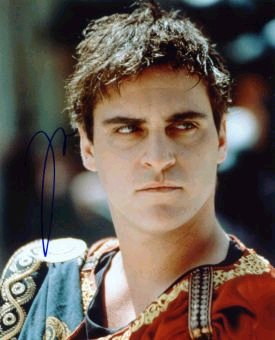
Greek dance is just as alive and well as it was in the past. Traditional dancing continues to be a popular aspect of social life here. We learned six dances, three variations of each different style. The island dances were much slower and flowing, "Like the waves of the ocean." The city dances combined faster movements with a bit of jumping. [By the way, our marching band routine was completely flawed.]
It was a wonderful experience! The small group made it easy to learn a lot in only two hours. Our instructor was unphased by the numbers and was an enthusiastic, helpful teacher. In the past, I believe an exhibition is held at the end of the semester where classes like ours from all over Athens get together and perform in front of an audience. We'll see...
Tuesday, February 01, 2005
Kalaitzakis
Sunday happened to be Maura's birthday, so before we met up with her, Katie and I put together a gift. I had brought a ND bottle opener (that played the fight song) to Athens just for an occasion like this. Katie bought a box mix of chocolate cookies and baked them. Well, our oven is very...European...so every time we use it is an experiment. Unfortunately for the cookies, they were one of the first experiments, and judging by their gooey goodness and crunchy doneness, we still have a way to go in understanding the oven's temperments.
Manos met up with us at mass, and afterword, both him and Maura invited us over to their apartment. The invitation was greatly appreciated and we made our way to the metro station. The metro in Athens was improved and cleaned up for the summer olympics. It is currently not only efficient and clean, but user friendly and cheap. A one-way ticket is .70 Euro and the abundance of maps and signs allows even a novice subway passenger like myself to understand where I'm at and where I'm going.
Their apartment is conveniently located 5 stops down the line near our own apartment in Kolonaki. They live in a neighborhood that Maura loosely compared to a suburb. While walking there, we passed a Hyundai dealership and I asked Manos if there was a native Greek car. There is! (Dad, I'm still looking for the little figure to prove it to you.) Maura and Manos live on the third floor of the building. Their apartment has a gorgeous balcony (everyone has those here) and cute artwork. I immediately went over to the framed photographs on a table. One in particular caught my attention: it was of Maura running the Chicago marathon!
In Greece, birthdays aren't celebrated like they are in the States. In fact, the same type of celebration that Americans would have for their birthdays is instead on the nameday of the person. Maura's name is related to Maria, which happens to be the biggest nameday of the year. (Shops close down and everything.) Knowing the cultural importance of birthdays to Americans, Manos and his family celebrated with her.
According to Maura:
- Manos’ name is really Emmanouil. The people who picked him up at the airport in the US nicknamed him that because they could not pronounce his name (sort of like Ellis Island or something). Manos is a Greek nickname, but he had never used it before.
- Manos’ dad’s name is Alexandros (or Alekos) Kalaitzakis. His girlfriend’s name is Maria.
- Manos’ aunt’s name is Katerina Papadaki (last name from her late husband, not a family name)
- Manos’ uncle’s name is Adonis Adoniadis
- Manos’ grandma’s name is the Greek version of Angela, but I am not sure how to write that because she is just gia-gia. (or as Americans pronouce it, 'yia-yia')
Manos & Maura, Alex (Alekos), and Katerina & Adonis all live in the same building. So, for the birthday celebration we all went up to the fifth floor apartment of Katerina & Adonis. Katie and I were welcomed with open arms. In addition to the family members, we met Rosa, the live-in. Katerina is a beautiful woman. The word "ritzy" comes to mind when visualizing her. She's a bit of a socialite and her apartment mirrors that. The decoration in that place was extraordinary. I felt like I needed to show someone my ticket of admission because the artwork on the wall is museum material. However, I was comfortable right away because everyone was so welcoming. She has a mid-sized, poodle-like dog with curly black fur named Carrie (or the Greek equivalent). Carrie spent no time in getting to know me and jumped right into my lap when I sat down.
Alex is a very tall man with a deep, rich voice and a gleam in his eye. With a flourish he brought in a delicious chocolate and strawberry cake for Maura. She jokes that he resembles James Bond, and in fact, Alex greeted us with, "Bond, James Bond." All sorts of images of Sean Connery in Astin Martins ran through my head. Alex's girlfriend Maria is radiant and knows a bit of English. She greeted us with, "You're welcome" which, at first, I thought was the wrong thing to say because I hadn't thanked her for anything, but then I realized that "you're welcome" is actually the more formal way of saying, "Later on we'll break out the ouzo."
Adonis is a dignified figure. He used to be a professional soccer player and is now the president of the Greek soccer federation, or something along those lines. He's a bit of a celebrity around here. Apparently, when Maura first met Adonis, he said, "You may call me Mr. President." It was all in good fun of course. Katie had this to say: Manos has an aunt who is married to a very famous former soccer star. If you can imagine being from somewhere like, say, France, finding yourself in a very nice living room eating birthday cake with an incredibly nice person you've only just met and a bunch of other nice people who are talking in a language you don't understand, while looking across the coffee table to watch Joe Montana take a swig of whiskey, then you'll know how Noelle and I felt. It was surreal.
All the family gathered around the table and sang a greek birthday song. The cake was topped with a candle that I'm sure could only be purchased at Reservations back home. As you can see in that weblinked picture, I look like an even minier version of myself. This is due to the fact that Manos is 6'6", with Maura and Alex not that far behind. For the record, I was ducking a little because I didn't think Alex was completely in the picture. However, looking back, I can see that was completely unnecessary.
Manos met up with us at mass, and afterword, both him and Maura invited us over to their apartment. The invitation was greatly appreciated and we made our way to the metro station. The metro in Athens was improved and cleaned up for the summer olympics. It is currently not only efficient and clean, but user friendly and cheap. A one-way ticket is .70 Euro and the abundance of maps and signs allows even a novice subway passenger like myself to understand where I'm at and where I'm going.
Their apartment is conveniently located 5 stops down the line near our own apartment in Kolonaki. They live in a neighborhood that Maura loosely compared to a suburb. While walking there, we passed a Hyundai dealership and I asked Manos if there was a native Greek car. There is! (Dad, I'm still looking for the little figure to prove it to you.) Maura and Manos live on the third floor of the building. Their apartment has a gorgeous balcony (everyone has those here) and cute artwork. I immediately went over to the framed photographs on a table. One in particular caught my attention: it was of Maura running the Chicago marathon!
In Greece, birthdays aren't celebrated like they are in the States. In fact, the same type of celebration that Americans would have for their birthdays is instead on the nameday of the person. Maura's name is related to Maria, which happens to be the biggest nameday of the year. (Shops close down and everything.) Knowing the cultural importance of birthdays to Americans, Manos and his family celebrated with her.
According to Maura:
- Manos’ name is really Emmanouil. The people who picked him up at the airport in the US nicknamed him that because they could not pronounce his name (sort of like Ellis Island or something). Manos is a Greek nickname, but he had never used it before.
- Manos’ dad’s name is Alexandros (or Alekos) Kalaitzakis. His girlfriend’s name is Maria.
- Manos’ aunt’s name is Katerina Papadaki (last name from her late husband, not a family name)
- Manos’ uncle’s name is Adonis Adoniadis
- Manos’ grandma’s name is the Greek version of Angela, but I am not sure how to write that because she is just gia-gia. (or as Americans pronouce it, 'yia-yia')
Manos & Maura, Alex (Alekos), and Katerina & Adonis all live in the same building. So, for the birthday celebration we all went up to the fifth floor apartment of Katerina & Adonis. Katie and I were welcomed with open arms. In addition to the family members, we met Rosa, the live-in. Katerina is a beautiful woman. The word "ritzy" comes to mind when visualizing her. She's a bit of a socialite and her apartment mirrors that. The decoration in that place was extraordinary. I felt like I needed to show someone my ticket of admission because the artwork on the wall is museum material. However, I was comfortable right away because everyone was so welcoming. She has a mid-sized, poodle-like dog with curly black fur named Carrie (or the Greek equivalent). Carrie spent no time in getting to know me and jumped right into my lap when I sat down.

Alex is a very tall man with a deep, rich voice and a gleam in his eye. With a flourish he brought in a delicious chocolate and strawberry cake for Maura. She jokes that he resembles James Bond, and in fact, Alex greeted us with, "Bond, James Bond." All sorts of images of Sean Connery in Astin Martins ran through my head. Alex's girlfriend Maria is radiant and knows a bit of English. She greeted us with, "You're welcome" which, at first, I thought was the wrong thing to say because I hadn't thanked her for anything, but then I realized that "you're welcome" is actually the more formal way of saying, "Later on we'll break out the ouzo."
Adonis is a dignified figure. He used to be a professional soccer player and is now the president of the Greek soccer federation, or something along those lines. He's a bit of a celebrity around here. Apparently, when Maura first met Adonis, he said, "You may call me Mr. President." It was all in good fun of course. Katie had this to say: Manos has an aunt who is married to a very famous former soccer star. If you can imagine being from somewhere like, say, France, finding yourself in a very nice living room eating birthday cake with an incredibly nice person you've only just met and a bunch of other nice people who are talking in a language you don't understand, while looking across the coffee table to watch Joe Montana take a swig of whiskey, then you'll know how Noelle and I felt. It was surreal.
All the family gathered around the table and sang a greek birthday song. The cake was topped with a candle that I'm sure could only be purchased at Reservations back home. As you can see in that weblinked picture, I look like an even minier version of myself. This is due to the fact that Manos is 6'6", with Maura and Alex not that far behind. For the record, I was ducking a little because I didn't think Alex was completely in the picture. However, looking back, I can see that was completely unnecessary.

Katie's Update
Because I'm a super-nice friend, and because Katie is funnier than I will ever be, I've opened up my weblog for her postings as well. Enjoy.
[Katie's opinions by no means necessarily reflect that of the site manager. :)]
I said I would keep in touch with everybody, but I understand that my storytelling habits may be overpowering (this word here means, "too time-consuming to be worth following"), so I won't blame you if you delete these emails. My own dear dad and my godfather have lovingly nicknamed me"DWOP," which is short for "Dialogue With Out Plot." Although they themselves can't generally remember the acronym they've given me, their analysis has at least a little truth to it, so please don't feel obligated to stick these emails out to the end.
Last Thursday, a bunch of us in the College Year in Athens Programs got together in small groups of about eight people and went with some of our professors to local tavernas for our first BIG Greek meal. It was awesome; after an ouzo toast, we had eggplant salad, tzatziki (cucumber sauce), feta cheese, a fabulous Greek salad, meatballs and sausage, more feta cheese, wine-soaked octopus, and calamari (DELICIOUS fried squid). Most shocking to me was the fact that I sat between TWO genuinely NICE guys from the University of Michigan. I never would have dreamed this was possible; I may have to reconsider the Tooth Fairy and the Easter Bunny.
On Friday, I reached a break through in my Modern Greek acquisition. After several hours of writing out the alphabet and trying get over the fact that what I know as the letter "p" sounds like "r" here, I finally found myself semi-capable of reading street signs. I did a victory dance.
On Saturday, Noelle and I caught a bus to a Carrefour, which can best be compared to Super Target. We acquired a few provisions (bread, olive oil, chicken, feta, three different kinds of olives, flan-in-a-box mix, etc.) and trekked back to our apartment to find that our other roommates had stocked the kitchen with frozen pizzas, macaroni & cheese, taco supplies and three different kinds of peanut butter. Our poor roommates are kind of struggling. "People magazine is like my Bible," one of them recently moaned. "I just don't know how I'm going to make it without that. And my miniskirt." Yeah, life's pretty rough for some of them. They're definitely not fans of the new cuisine, or of the Greek people, for that matter . . . But they love the bars here, so I'm sure they'll do just fine.
Speaking of silly struggles, though, Noelle and I made cucumber and feta sandwiches for dinner on Saturday. We had been really proud of ourselves for piecing together enough Modern Greek in Carrefour to recognize the word sodium on a spice shaker that looked like it might contain salt. Boy was I surprised to find myself sprinkling baking soda on my sandwich. Yummy.
Sunday was the pinnacle of our weekend, both in action and in hilarity. Noelle and I met up with Maura, a friend of Noelle's who graduated from Notre Dame. Maura's husband, Manos, is a Greek man who came to the US as a transfer student when he was a junior in high school so that he could play basketball in the states. They're living in Athens now because Manos is still a Greek citizen, and all male Greeks are required to serve in the military for at least nine months. Well anyways, Noelle and I met up with Maura, and she gave us an awesome walking tour of the heart of the city. She showed us some places to get delicious, authentic souvlakis and gyros (delicious Greek sandwiches on pita) for dirtcheap, and she pointed out some fun local pubs. The she took us up to Acropolis Hill, which consists of the remains of really, really ancient Athens. We stood on a huge rock upon which St. Paul supposedly gave his first sermon in the area, and the view was amazing. We were in the shadows of the Parthenon, and we could see both the sea and the immense, sprawling city as we watched clouds rolling over the mountains.
Then we met up with Manos and went to church. Since no actual Greek person in this town is ROMAN Catholic, mass was a hilarious little adventure in subculture. It turns out that there's a huge Filipino contingent in Athens; probably half the church or better consisted of families of women who work as live-in servants here in Greece. I was delighted; my best friend Anna-Lisa is Filipino, and oure xtensive families have spent YEARS imparting various aspects of Irish andFilipino culture to the two of us, so I felt right at home. The beauty of the situation, though, was that most of the other half of the church was made up of African people from at least a couple different countries. So there we were, the African people speaking French and Greek intermittently, the Filipino people bouncing here and there with snippets of Tagalog, Greek and English. The priest was British, which wouldn't have been so funny if I hadn't watched nearly so much of the cartoon VeggieTales with my little brothers and sisters. This priest sounded just like the big old whiny asparagus. (If you've never been so fortunate as to have experienced VeggieTales, just imagine a British man with a high-pitched, nasally voice scolding a cartoon cucumber with the words, "Stop!Stop! Stop! You can't say 'everybody's got a water buffalo,' when everyone doesNOT have a water buffalo! We’re going to get nasty letters . . .”)
Well, to make a long story somewhat shorter, we dumb Americans and the priest were probably the only people in the church who spoke English as a first language. Mass was something that seemed almost really familiar, but just a little garbled. The whole thing was delightful pandemonium, a nice break from the uptight, single-file, no-maracas-involved fare that my parish dishes up (That’s not a complaint, though I myself am a huge fan of maracas). The cantor, who had an awesome voice, performed a very dramatic, near-sobbing rendition of the psalm that went something like this: "and-da-Lord, he thwart theWEEEEEcked, he-will-smite-them-for-der INE-E-E-EQUITY." The priest's homily involved the following line: "What Jesus is saying is that people won't go to hell for not following the Ten Commandments. I mean, they WILL go to hell, but not for that." And by the end of the service, all six of the little altar servers were dead asleep in their chairs. It was hysterical, and I really, really want to join the choir.
I’m sure that there will be more to come, if you can handle it. Until then, cheers and “kaλnμερα,” which means, “Good day.”
[Katie's opinions by no means necessarily reflect that of the site manager. :)]
I said I would keep in touch with everybody, but I understand that my storytelling habits may be overpowering (this word here means, "too time-consuming to be worth following"), so I won't blame you if you delete these emails. My own dear dad and my godfather have lovingly nicknamed me"DWOP," which is short for "Dialogue With Out Plot." Although they themselves can't generally remember the acronym they've given me, their analysis has at least a little truth to it, so please don't feel obligated to stick these emails out to the end.
Last Thursday, a bunch of us in the College Year in Athens Programs got together in small groups of about eight people and went with some of our professors to local tavernas for our first BIG Greek meal. It was awesome; after an ouzo toast, we had eggplant salad, tzatziki (cucumber sauce), feta cheese, a fabulous Greek salad, meatballs and sausage, more feta cheese, wine-soaked octopus, and calamari (DELICIOUS fried squid). Most shocking to me was the fact that I sat between TWO genuinely NICE guys from the University of Michigan. I never would have dreamed this was possible; I may have to reconsider the Tooth Fairy and the Easter Bunny.
On Friday, I reached a break through in my Modern Greek acquisition. After several hours of writing out the alphabet and trying get over the fact that what I know as the letter "p" sounds like "r" here, I finally found myself semi-capable of reading street signs. I did a victory dance.
On Saturday, Noelle and I caught a bus to a Carrefour, which can best be compared to Super Target. We acquired a few provisions (bread, olive oil, chicken, feta, three different kinds of olives, flan-in-a-box mix, etc.) and trekked back to our apartment to find that our other roommates had stocked the kitchen with frozen pizzas, macaroni & cheese, taco supplies and three different kinds of peanut butter. Our poor roommates are kind of struggling. "People magazine is like my Bible," one of them recently moaned. "I just don't know how I'm going to make it without that. And my miniskirt." Yeah, life's pretty rough for some of them. They're definitely not fans of the new cuisine, or of the Greek people, for that matter . . . But they love the bars here, so I'm sure they'll do just fine.
Speaking of silly struggles, though, Noelle and I made cucumber and feta sandwiches for dinner on Saturday. We had been really proud of ourselves for piecing together enough Modern Greek in Carrefour to recognize the word sodium on a spice shaker that looked like it might contain salt. Boy was I surprised to find myself sprinkling baking soda on my sandwich. Yummy.
Sunday was the pinnacle of our weekend, both in action and in hilarity. Noelle and I met up with Maura, a friend of Noelle's who graduated from Notre Dame. Maura's husband, Manos, is a Greek man who came to the US as a transfer student when he was a junior in high school so that he could play basketball in the states. They're living in Athens now because Manos is still a Greek citizen, and all male Greeks are required to serve in the military for at least nine months. Well anyways, Noelle and I met up with Maura, and she gave us an awesome walking tour of the heart of the city. She showed us some places to get delicious, authentic souvlakis and gyros (delicious Greek sandwiches on pita) for dirtcheap, and she pointed out some fun local pubs. The she took us up to Acropolis Hill, which consists of the remains of really, really ancient Athens. We stood on a huge rock upon which St. Paul supposedly gave his first sermon in the area, and the view was amazing. We were in the shadows of the Parthenon, and we could see both the sea and the immense, sprawling city as we watched clouds rolling over the mountains.
Then we met up with Manos and went to church. Since no actual Greek person in this town is ROMAN Catholic, mass was a hilarious little adventure in subculture. It turns out that there's a huge Filipino contingent in Athens; probably half the church or better consisted of families of women who work as live-in servants here in Greece. I was delighted; my best friend Anna-Lisa is Filipino, and oure xtensive families have spent YEARS imparting various aspects of Irish andFilipino culture to the two of us, so I felt right at home. The beauty of the situation, though, was that most of the other half of the church was made up of African people from at least a couple different countries. So there we were, the African people speaking French and Greek intermittently, the Filipino people bouncing here and there with snippets of Tagalog, Greek and English. The priest was British, which wouldn't have been so funny if I hadn't watched nearly so much of the cartoon VeggieTales with my little brothers and sisters. This priest sounded just like the big old whiny asparagus. (If you've never been so fortunate as to have experienced VeggieTales, just imagine a British man with a high-pitched, nasally voice scolding a cartoon cucumber with the words, "Stop!Stop! Stop! You can't say 'everybody's got a water buffalo,' when everyone doesNOT have a water buffalo! We’re going to get nasty letters . . .”)
Well, to make a long story somewhat shorter, we dumb Americans and the priest were probably the only people in the church who spoke English as a first language. Mass was something that seemed almost really familiar, but just a little garbled. The whole thing was delightful pandemonium, a nice break from the uptight, single-file, no-maracas-involved fare that my parish dishes up (That’s not a complaint, though I myself am a huge fan of maracas). The cantor, who had an awesome voice, performed a very dramatic, near-sobbing rendition of the psalm that went something like this: "and-da-Lord, he thwart theWEEEEEcked, he-will-smite-them-for-der INE-E-E-EQUITY." The priest's homily involved the following line: "What Jesus is saying is that people won't go to hell for not following the Ten Commandments. I mean, they WILL go to hell, but not for that." And by the end of the service, all six of the little altar servers were dead asleep in their chairs. It was hysterical, and I really, really want to join the choir.
I’m sure that there will be more to come, if you can handle it. Until then, cheers and “kaλnμερα,” which means, “Good day.”
Maura's Famous Walking Tour
Sunday afternoon, Katie and I had the most wonderful time with a ND grad named Maura. This requires a little explanation.
Maura graduated from ND in 2001. She is very good friends with Brian Hart, who also graduated that year from ND, and who happens to have attended Connell High School. When Shelece and I first visited the campus, we stayed with Maura in Lewis Hall because Brian was showing us around.
Maura married a Greek named Manos. Manos was an exchange student who moved to Minnesota at sixteen and played basketball. They met in high school and have been inseparable since. In Greece, every male is required to perform a certain amount of military service. So, Maura and Manos are living in Athens, while he fulfills this requirement. Upon learning we were coming to Athens, Maura graciously offered to show us around.
Yesterday, Maura met up with us and gave us her famous walking tour of Athens. It was spectacular! We found out our neighborhood, Kolonaki, is probably the most central and best location in the city. It is within walking distance of most everything. And walk we did! We saw many, many places and things, such as the Parliament building, ancient Agora, and Acropolis. Maura gave us the tour of Kolonaki (pointing out great places to eat and drink) and Plaka (neighborhood in which there tons of little shops and souvlaki).
The tour ended with mass at the Catholic Church of St. Denis. This church has one English language mass a week at 6 PM. We got there early so we could get a seat. Most attendees are foreigners who's common second or third language is English. It is interesting to note that there is a significant Filipino population in Athens. Apparently, many have traveled here to be "live-ins" or house servants for the Greeks. There were also quite a few Africans and foreign students there. The church completely filled up and many people were left standing during mass.
The mass itself was quite fun. The music was a distinctly original Filipino/African mix, and the choir was pretty good for only practicing an hour before mass. Katie is thinking of joining! It is always fun going to a service in which either you don't know the words, can't read the words, or can't understand what you're supposed to be repeating. [I must add here that we had a terrible giggle loop moment during the Psalm. I had no idea what the response was...and neither did many others, which apparently means the proper response is to replace what is unintelligible with like sounding words...the result of which is another unintelligible group of words that can be very funny for a listener like myself.]
Another amusing aspect was that there is no rhyme or reason to the Communion line and people leave their pews whenever they feel like it. While in line I happened to notice the vast amount of altar servers there were. I believe I counted eight or so. Many of them looked very, very bored, and one in particular was leaning across his seat yawning. They all looked Filipino to me. Some had "asian street gang" hair, otherwise known as a rat-tail. The priest said, "this is the body of Christ" in Greek, to which I replied, "amen." Maura on the other hand said, "εuχαριστw," which means "thank you." Oops. hahaha She's been taking Greek lessons and I guess they paid off!
Maura graduated from ND in 2001. She is very good friends with Brian Hart, who also graduated that year from ND, and who happens to have attended Connell High School. When Shelece and I first visited the campus, we stayed with Maura in Lewis Hall because Brian was showing us around.
Maura married a Greek named Manos. Manos was an exchange student who moved to Minnesota at sixteen and played basketball. They met in high school and have been inseparable since. In Greece, every male is required to perform a certain amount of military service. So, Maura and Manos are living in Athens, while he fulfills this requirement. Upon learning we were coming to Athens, Maura graciously offered to show us around.
Yesterday, Maura met up with us and gave us her famous walking tour of Athens. It was spectacular! We found out our neighborhood, Kolonaki, is probably the most central and best location in the city. It is within walking distance of most everything. And walk we did! We saw many, many places and things, such as the Parliament building, ancient Agora, and Acropolis. Maura gave us the tour of Kolonaki (pointing out great places to eat and drink) and Plaka (neighborhood in which there tons of little shops and souvlaki).
The tour ended with mass at the Catholic Church of St. Denis. This church has one English language mass a week at 6 PM. We got there early so we could get a seat. Most attendees are foreigners who's common second or third language is English. It is interesting to note that there is a significant Filipino population in Athens. Apparently, many have traveled here to be "live-ins" or house servants for the Greeks. There were also quite a few Africans and foreign students there. The church completely filled up and many people were left standing during mass.
The mass itself was quite fun. The music was a distinctly original Filipino/African mix, and the choir was pretty good for only practicing an hour before mass. Katie is thinking of joining! It is always fun going to a service in which either you don't know the words, can't read the words, or can't understand what you're supposed to be repeating. [I must add here that we had a terrible giggle loop moment during the Psalm. I had no idea what the response was...and neither did many others, which apparently means the proper response is to replace what is unintelligible with like sounding words...the result of which is another unintelligible group of words that can be very funny for a listener like myself.]
Another amusing aspect was that there is no rhyme or reason to the Communion line and people leave their pews whenever they feel like it. While in line I happened to notice the vast amount of altar servers there were. I believe I counted eight or so. Many of them looked very, very bored, and one in particular was leaning across his seat yawning. They all looked Filipino to me. Some had "asian street gang" hair, otherwise known as a rat-tail. The priest said, "this is the body of Christ" in Greek, to which I replied, "amen." Maura on the other hand said, "εuχαριστw," which means "thank you." Oops. hahaha She's been taking Greek lessons and I guess they paid off!
Subscribe to:
Posts (Atom)