
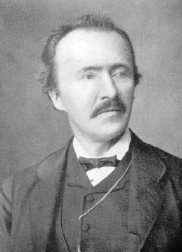
[Sidenote: Schliemann and Arthur Evans, who discovered Minoan civilization, dug up the respective sites in the late 19th century. Coincidence? Two of the most notable excavations ever, occurring at roughly the same time...Why is this? Certainly there had been rich men looking for hobbies in the past. Why hadn't others found this outlet for their money? With regards to Mycenae, the famed "lion's gate" was outright visible. Shepherds and villagers knew it existed, and SEEN it, for centuries. Why wasn't it taken into consideration long before Schliemann's time? The answer has to do with the Theory of Evolution. Before Darwin, there WAS NO ancient past. Before Darwin, the earth was 4000 years old and there was no reason to look for something that simply didn't exist. At least, that's the way it was until the 19th century. (exceptions notwithstanding)]
The Mycenaean civilization was given that name because the first, and coincidentally biggest site unearthed was the citadel/city of Mycenae. There is a great debate as to if the city was an urban center or more a glorified citadel. Archaeological evidence can support both theories, but for simplicity, I'll call it a city. It is located on a hilltop next to a mountain, looking down onto a plain. The landscape provided protection against enemies. The Mycenaeans built on that site specifically because of its defensive advantages, and also because of the nature of their local economy and trade. The city was inhabited for about 5,000 years (~5000 BC-1AD) and then completely abandoned when power shifted to Argos. Of the 5000 years, only 400 are really important.
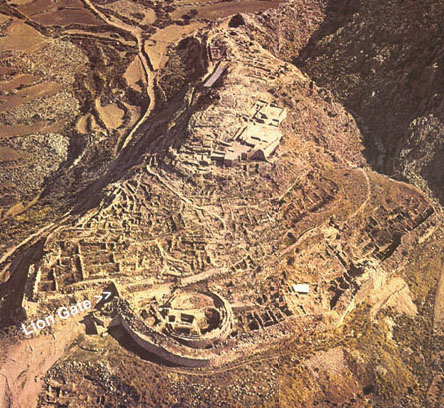
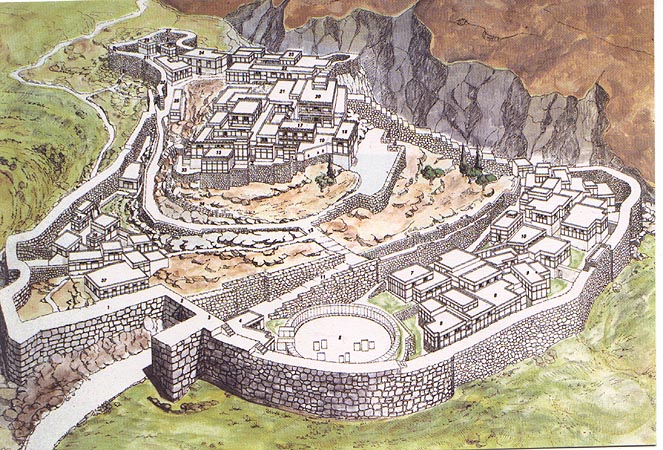
The site itself is staggering. Here is an aerial shot and reconstruction. Mycenae developed into a town in the early proto-urban period. It putted along until, suddenly, tremendous wealth was introduced.
~1600-1400 BC - Early Mycenaean Age
Most of the evidence of acquired wealth is found in graves. For about 200 years, the Mycs. were filthy, stinking rich, and one of their favorite things to do with all of this wealth was to make really ornate jewelry and weapons to bury with their dead. Grave Circle B and Grave Circle A contained extraordinary examples of these types of expensive grave goods. It is interesting to note that these goods were made for the specific purpose of being buried with the body. The pieces were not objects owned and used, then buried with the owners. We know this because, for example, the jewelry was made of delicate, thin gold leaf, intricately decorated, which could not have been worn by anybody with a pulse. Katie says, "I mean, I guess you could argue that some trophy-wife queens may not have moved much, but even they would have had to go to the bathroom eventually." These people were so rich that they practically shoveled in gold leaf "coins" to top off the burial. Also buried were weapons (swords, daggers) with that were entirely impractical. The blades were made of bronze, the handles of gold. Anyone who knows anything about metal could tell you this: a handle made of gold would be crushed under the grip of a man meeting battle, and a blade made of bronze, such as it was, could "barely cut through butter on a hot day." (Prof. Diamant)
Grave Circle B predates Grave Circle A, but GCA was discovered first by Schliemann; hence, the backwards alphabetization. (No, I don't know if that's a word or not.)
Some of the most remarkable discoveries in the graves were the so-called "death masks." These were made of metal and shaped to form a face, or mask, that covered the dead person's. The earlier examples were made from a mixture of silver and gold, but the later ones were pure gold. They are thought NOT to be exact likenesses of the buried, but are instead based on general characteristics of the people: male, fat, etc. [At least, we HOPE they weren't exactly accurate!] Now comes the controversy. Schliemann dug up GCA and found many pretty things. However, there is one artifact in particular that legend says inspired Schliemann to telegrammed a Greek newspaper, "I have gazed on the face of Agamemnon." Schliemann was a self-mythologizer. He liked to draw connections where there were none in order to boost the impressiveness of his findings. The greatest example of this is the "mask of Agamemnon." This particular death mask was stylistically different than all the others: facial hair, ears cut out from the body of the mask. Yet Schliemann never noted this. All the graves date to at least 300 years BEFORE the Trojan war (in which Agamemnon played a part). There is no evidence that Agamemnon was buried here, and some would say not enough to believe he existed at all. The point is, some scholars have doubts as to whether this mask is Mycenaean in the first place. There are some who believe Schliemann may have forged it himself. Whatever the case may be, it is one of the most popular artifacts visited in the National Archaeological Museum in Athens.
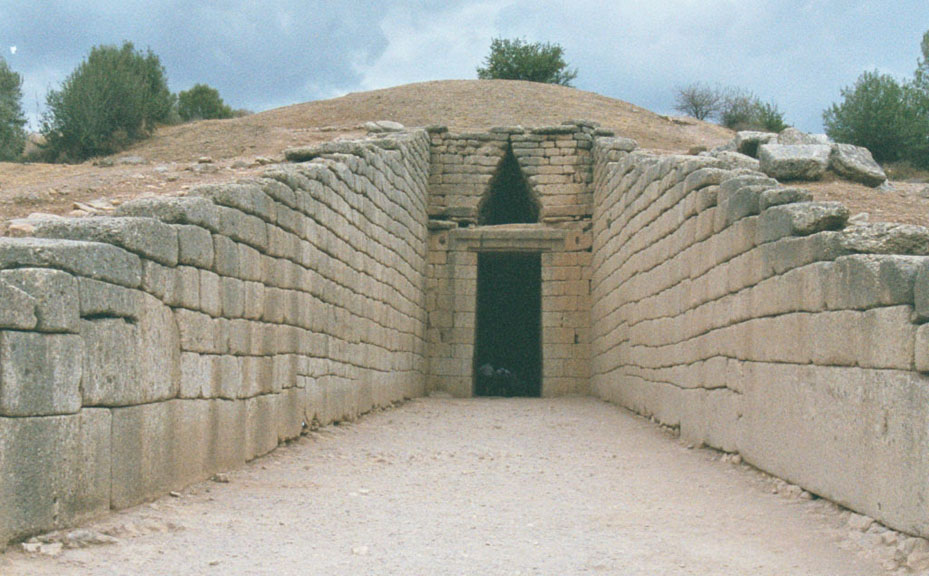
Later Myc. Age - Mycenaean architecture shifted from the dead to the living. During this age, Mycenae was the richest city in the Aegean for 150 years. The Mycenaeans were OBSESSED with building insanely huge structures out of ridiculously massive but masterfully cut rocks. This is called "cyclopean architecture" because it was once believed that only the giant Cyclops could have moved those rocks. The site remains the way it is today because of the enormous scale of the structures. You find cyclopean, also called "monumental" architecture throughout the citadel, graves, defensive walls, and in the tholos tombs. Tholos tombs, meaning "round" tombs, were built into the sides of hills. One tomb in particular is so complicated in construction, so monumental in size that it should be called one of the world's ancient wonders. It is almost completely whole and is standing tall for visitors to admire. [It is sometimes referred to as "The Treasury of Atreus" which makes absolutely no sense and is completely innacurate.] This tomb is 3000 years old.
~1250 BC - Myc. reached its peak. Evidence: 1) A group of rich merchant houses burnt down outside the city walls. This baked hard the previously temporary clay Linear B tablets (Myc. language) that were used to keep inventories. 2) They built an elaborate secret cistern with access within the defensive walls-this suggests that the elites weren't too happy with what was happening on the outside. 3) Exports of pottery ceased.
~1200 BC - Inside the citadel caught fire, but the palace was spared. The population declined and no more monumental architecture was undertaken.
~1150 BC - A fire destroyed the palace.
After 1150 BC - The site continued to be occupied, but its role was greatly diminished. Other cities (such as Argos) increased in power.
~1 AD - The site was completely deserted.
Aspects of the Mycenaean civilization:
They were willing to rip off anybody. Mycenaean art is a blatant conglomeration of various artforms, motifs, and materials of other cultures like the Minoans or Cyclades. It is quite obvious and they were not ashamed of it.
They loved gold. One look at the excavated grave goods and you can only begin to imagine what they didn't put in with their dead.
They were megalomaniacs. They built big buildings...because they could. The defensive walls were exponentially bigger than they ever needed to be. One American army officer commented that it would take at least three blasts from a howitzer to break through that amount of rock. They must have been paranoid as well. Exactly what this little prehistoric town of farmers and traders felt it needed to defend itself from is still a mystery . . .
This society was sharply divided between the elite and everyone else. While the elite (10% of pop.) was buried with fortunes, the rest of the population was dirt-poor. It must have sucked for most of them. (No, I don't believe that is the scientific term.)






No comments:
Post a Comment