
Our hotel was located in Nafplion, a city that happens to be in an excellent location, both relative to the archaeological sites and in a general sense.
Nafplio, also called Nafplion
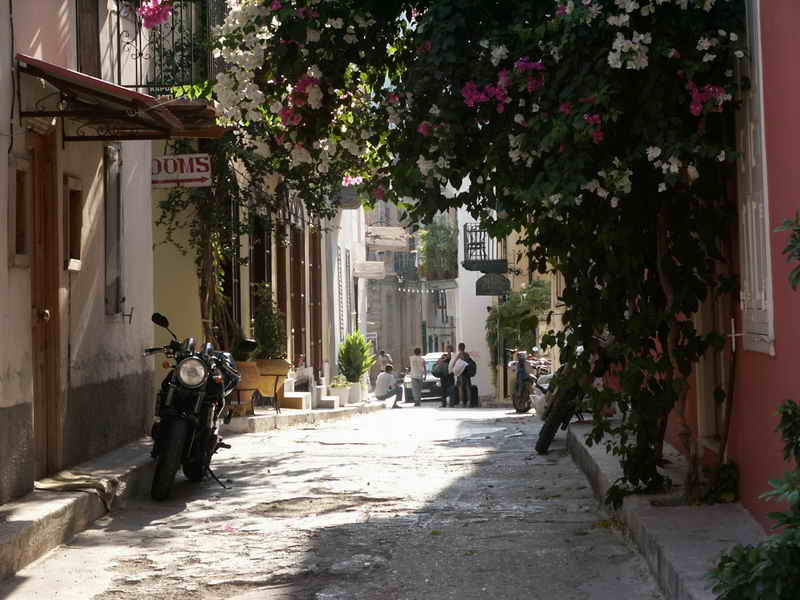
When first approaching this city, it appears cute, quaint, and relaxed. It wasn't tourist season yet, so the streets were relatively uncrowded, the exceptions being locals. Nafplion sits on a peninsula of strategic importance to the Peloponnese.
In ancient times, Nafplion made a great port for the nearby powerful city of Argos. Because of the location's commercial advantages, it was sacked by Venetian traders (known skilled merchants) who secured the port and used it for their own trading industry. The local population suffered greatly under the Italian rule and many welcomed the later Ottoman invasion that forced the Venetians out. This power turnover occurred when the Turks climbed a big hill next to the city's stronghold and shot their big canons down onto it. The Venetians got scared, jumped in their little boats, and sailed away. (No word on if they wore striped shirts and sang tragic songs from their gondolas.) The Turks built a big mosque and with a Islamic school attached, but aside from that, they pretty much left the townspeople alone for the next hundred years or so. During this time, Nafplion was pretty quiet.
Then the Venetians decided they had gathered enough strength to fight back, so they brought bigger guns, climbed up the that same hill overlooking the stronghold, fired down on the city, and "freed" Nafplion from the Ottoman Empire. One of first contributions to the city was turning the Islamic school into a prison. Though christians themselves, the Venetians did little to gain the prasises of the locals. Neither the townspeople nor the overworked and underpaid Venetian soldiers sent to occupy the area were very happy with this arrangement.
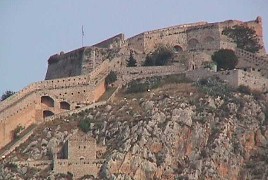
The Venetians, in a light bulb moment, had caught onto the fact that the big hill next to the stronghold might be a strategic weakness as far as defense of the city was concerned. Therefore, they decided to build a huge, "impregnable" fortress on top of it, eliminating the possibility of deja-vous. This is called the Palamidi fortress. So intent on securing the city were they, that the entire fortress, which is actually an impressive series of interconnected bastions, was built in a period of just four years. The underpaid and overworked Venetian soldiers who constructed it were pretty tired, hungry, and fed up by the time they finished the Palamidi along with the 1,000 stepped-staircase leading up to it. [photo from Palamidi, looking down at the stronghold] Again, the Turks came along with their bigger guns. Only this time, they met little resistance. In essence, the Venetians soldiers took one look at the Turks, threw down their weapons and said, "To hell with it." They ran out of the bastions via their recently-constructed covered walkways: some disappeared into the woodwork, while others took the conveniently located seaside stairs to their little boats, and went home. The Venetian nobles had to find their own way home, and they did so...quickly.
Just when you thought the story couldn't get any more ironic, the invincible fortress of Palamidi played a role in the Greek War of Independence when a local hero took it upon himself to scale the supposedly un-scale-able cliff side of the fortress, sneak over the walls and throw open the main gates. The Turks, who faced much bigger problems elsewhere in the mainland were defeated. So there you have it: the "impregnable" fortress batted .000, being brought down twice on two attemptes, and there was much rejoicing.
Once Greece became independent, Nafplion was very briefly made the new country's capitol. The mosque and Islamic school that had been turned into a prison by the Venetians was recycled yet again. It became the building in which the first Greek parliament met. Is was here that the first governor of the nation, Ioannis Kapodistrias was assassinated. Not long after that, the king of Greece moved the capitol to the more populous, and historical capitol, city of Athens. Since then Nafplion has returned to a quiet, vacation destination. [If I've confused you, here is a link to a short history of Nafplion.]
One of the remnants of the Venetian rule is a small Greek Catholic population. We walked by a Catholic church, but during the winter masses are held only once a month because the priest travels into the city.
I'm not sure if this is connected to the Venetians, but there is a gelato place with the best gelato I've ever had. I will try to upload some pictures of it soon.
Our group took the bus up to the top of the Palamidi. Katie and I walked all the way to the top and took photos (also to be uploaded soon). After gawking at the gorgous Mediterranean, we took each and every of the 991 steps to the bottom. It was amazing. Whenever we had spare time, we ate great Greek food and hung out by the sea. The locals were polite and seemed much more relaxed than their Athenian contemporaries. Hell, if I lived in a place like this, I'd be relaxed too.




1 comment:
I want to go on your next field trip! I did like the history lesson, especially the parts about the Venetians running back to the little boats. The image in my head was quite comical.
-Maria
PS. I get to go to New Mexico on a Field Trip while I am here and (while it is not as exotic as Nafplion) it is gonna rock! (pun extremely intended as this is a geology field trip)
Post a Comment